In this section, Paul receives leave and is finally able to return home and visit family. However, as we read, Paul does not have the sense of relief that would be expected. He does not feel ‘at home,’ and is instead bothered by people’s questions or assumptions about the war. For example, “Some of these people ask questions, some ask no questions, but no one can see that the latter are proud of themselves for their silence” (168). How is quiet represented in the novel? Why is quietness “so unattainable for them now?” (121)?
In class we have discussed the juxtaposition between the beauty of nature with the horrors of war. For example, “One morning two butterflies play in front of our trench…They settle on the teeth of a skull” (127). What does nature symbolize in the novel? Is there any repetition of particular animals or landscapes, and what do they represent?
What is the relationship of time in the novel? Does Paul live in the present moment, or is he often revisiting memories from the past?
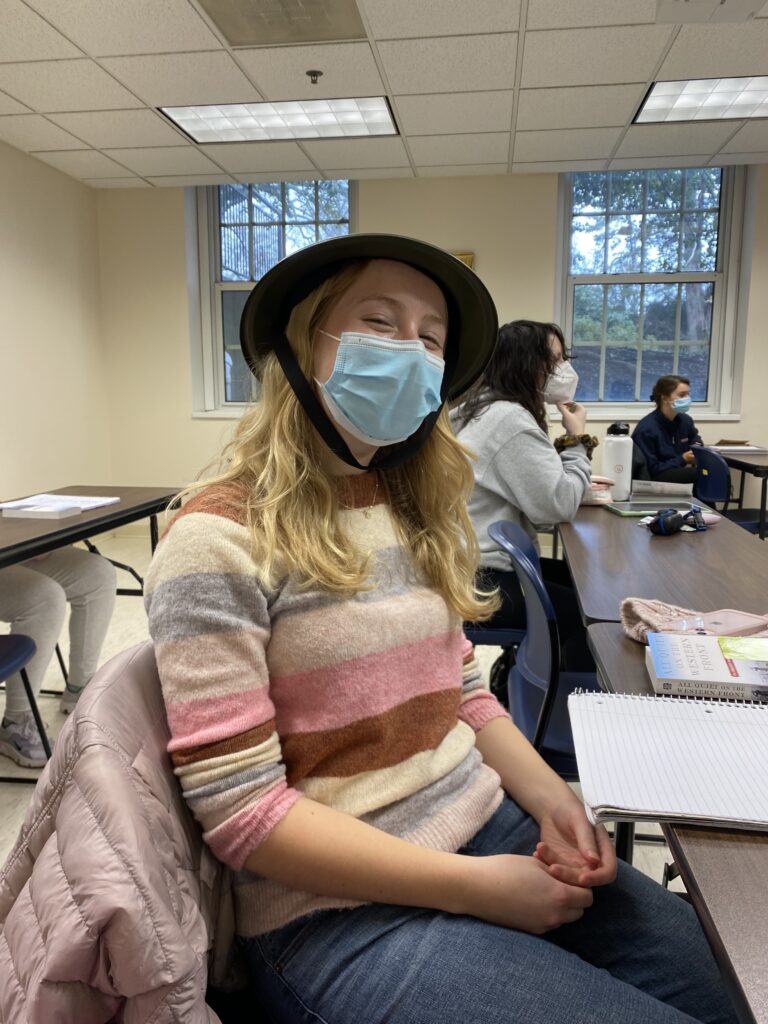
This is me with the special hat today in class! (Who will I give it to next time?? Heehee)
4 thoughts on “Ella’s Reading Q’s for 1/25 (Ch. 6-8)”
1, The concept of home is different for everyone. Some will say home is a person rather than a place, but I tend to moreso view home as a feeling. When I first thought about the concept of home as a feeling in regards to All Quiet on the Western Front, I was going to say home is safety and comfort, but the more I think about it, maybe home is more a sense of belonging than anything else. As a child, Paul felt he belonged at home; from his book collection to the group of boys he spent time with, he knew what his role was and knew how to act. However, home has shifted to the front when he is with other soldiers, specifically Kat, as he feels the comfort he once received from his books and family as Remarque writes “I belong to them and they to me…I could bury my voice in them, in these voices, these words that have saved me and will stand by me”(212). When he takes leave and returns “home” Paul, in contrast, says “‘I am not myself there. There is a distance, a veil between us’”(160). His words suggest he views home as where he feels like himself and is understood. He cannot view his birthplace as his home anymore because there is an unspeakable gap between the boy he was and the man he has become. At the front, he is in constant danger and faces terrible conditions everyday, but at least he feels like he belongs. The quietness you mention in this question has an interesting relationship with Paul’s interpretation of home. Quiet in general can be so many different things; in some instances, quiet is a symbol of awkwardness if people do not know what to say to one another, but on a deeper level silence can symbolize home because quiet means people can understand one another without words. In the novel, Remarque displays quiet as both an expression of comfort and an expression of discomfort. For instance, Paul longs for “the quiet rapture”(171) he used to feel at home, but that quiet has turned into an awkwardness as Paul and his mother have nothing to talk about as she refrains from asking questions about the front. She may be proud of her silence, but for Paul it is a constant reminder of how his mother no longer truly knows him. Paul now feels more comfortable in silence with men like Kat who he knows understand him without needing to ask the difficult questions. Ultimately, however, true quiet is only attainable in death for Paul and the other members of the Lost Generation because those who survive will never escape the noise of their memories from the war.
For the third question:
I think Paul finds it difficult to remember his past self – we see this especially when he’s at home trying to reminisce about his bookworm days – and also to look towards his future. I think that his only option is to live in the present, as reflected in his discussion with his comrades about what they will do after the war earlier in the story. They cannot imagine a future without fighting because they are the Lost Generation.
This follows in the novel with how difficult it is to gauge exactly how much time has passed between one event and the next, especially in the battle scenes. Like Paul, we as readers experience time like a flurry of the present because it is all we can bear to concentrate on.
Question 2 Response:
I think the most prominent element of nature so far in the novel is the earth itself. By this I mean the actual surface of the earth. The earth can be seen providing Paul and his fellow comrades with services such as protection and comfort. For example, Paul and his men during the bombardments saw their dugout as the only safe place. Another example is when Kat and Paul use the holes in the earth created by bombs as an attempt to stay safer because bombs often stay on the same plane they were thrown from. To the men of company 2, the earth and its soil are beautiful. It represents stability and comfort as it is even compared to mothers for its nurturing features. However, a stark contrast can be seen after seeing pictures of the battlefields and trenches. The earth does not look beautiful due to the horrors of war, but to the soldiers it provided them with an element of beauty unrelated to appearance.
Question 3: What is the relationship of time in the novel? Does Paul live in the present moment, or is he often revisiting memories from the past?
I wish there was a simple answer, but Paul seems be living in the past, present, and future all at once. He has memories from before the war but can no longer relate to his old life. Paul also has thoughts of the future but cannot fathom what life will be like because the war has such strong implications on the way he views life. As a class we have heard the generation of men who served in the war referred to as the “lost generation” and I cannot help but feel Paul is also lost within the past, present, and future of his own life.

1, The concept of home is different for everyone. Some will say home is a person rather than a place, but I tend to moreso view home as a feeling. When I first thought about the concept of home as a feeling in regards to All Quiet on the Western Front, I was going to say home is safety and comfort, but the more I think about it, maybe home is more a sense of belonging than anything else. As a child, Paul felt he belonged at home; from his book collection to the group of boys he spent time with, he knew what his role was and knew how to act. However, home has shifted to the front when he is with other soldiers, specifically Kat, as he feels the comfort he once received from his books and family as Remarque writes “I belong to them and they to me…I could bury my voice in them, in these voices, these words that have saved me and will stand by me”(212). When he takes leave and returns “home” Paul, in contrast, says “‘I am not myself there. There is a distance, a veil between us’”(160). His words suggest he views home as where he feels like himself and is understood. He cannot view his birthplace as his home anymore because there is an unspeakable gap between the boy he was and the man he has become. At the front, he is in constant danger and faces terrible conditions everyday, but at least he feels like he belongs. The quietness you mention in this question has an interesting relationship with Paul’s interpretation of home. Quiet in general can be so many different things; in some instances, quiet is a symbol of awkwardness if people do not know what to say to one another, but on a deeper level silence can symbolize home because quiet means people can understand one another without words. In the novel, Remarque displays quiet as both an expression of comfort and an expression of discomfort. For instance, Paul longs for “the quiet rapture”(171) he used to feel at home, but that quiet has turned into an awkwardness as Paul and his mother have nothing to talk about as she refrains from asking questions about the front. She may be proud of her silence, but for Paul it is a constant reminder of how his mother no longer truly knows him. Paul now feels more comfortable in silence with men like Kat who he knows understand him without needing to ask the difficult questions. Ultimately, however, true quiet is only attainable in death for Paul and the other members of the Lost Generation because those who survive will never escape the noise of their memories from the war.
For the third question:
I think Paul finds it difficult to remember his past self – we see this especially when he’s at home trying to reminisce about his bookworm days – and also to look towards his future. I think that his only option is to live in the present, as reflected in his discussion with his comrades about what they will do after the war earlier in the story. They cannot imagine a future without fighting because they are the Lost Generation.
This follows in the novel with how difficult it is to gauge exactly how much time has passed between one event and the next, especially in the battle scenes. Like Paul, we as readers experience time like a flurry of the present because it is all we can bear to concentrate on.
Question 2 Response:
I think the most prominent element of nature so far in the novel is the earth itself. By this I mean the actual surface of the earth. The earth can be seen providing Paul and his fellow comrades with services such as protection and comfort. For example, Paul and his men during the bombardments saw their dugout as the only safe place. Another example is when Kat and Paul use the holes in the earth created by bombs as an attempt to stay safer because bombs often stay on the same plane they were thrown from. To the men of company 2, the earth and its soil are beautiful. It represents stability and comfort as it is even compared to mothers for its nurturing features. However, a stark contrast can be seen after seeing pictures of the battlefields and trenches. The earth does not look beautiful due to the horrors of war, but to the soldiers it provided them with an element of beauty unrelated to appearance.
Question 3: What is the relationship of time in the novel? Does Paul live in the present moment, or is he often revisiting memories from the past?
I wish there was a simple answer, but Paul seems be living in the past, present, and future all at once. He has memories from before the war but can no longer relate to his old life. Paul also has thoughts of the future but cannot fathom what life will be like because the war has such strong implications on the way he views life. As a class we have heard the generation of men who served in the war referred to as the “lost generation” and I cannot help but feel Paul is also lost within the past, present, and future of his own life.