
To me, the most powerful section in the first three chapters is the conversation between Edwards and the B.F. regarding the war and why it is being fought. This is where the brainwashing of citizens by politicians and leaders comes to the forefront. The B.F. and Edwards directly contrast on whether or not the war is something worth fighting for. The B.F. is brainwashed by politicians and the church as she says, “We are in the right, aren’t we?…The Church says so dear.” Unlike her fellow ambulance driver, Edwards is able to look past the brainwashing and instead comments, “We came out here puffed out with patriotism. There isn’t one of us who wouldn’t go back tomorrow.” The B.F. represents the brainwashed citizens of the countries at war and Edwards represents the worn out soldiers who know the reality of the war. This section also draws parallels to All Quiet on the Western Front as Paul mentions how this is a war being fought in reality by 30 or so leaders who use their people as pawns. It really points to the insignificance that the leaders regard their people with and just how much power they really have as they are able to brainwash people into killing others just because of their nationalistic affiliation. One part that Smith brings in that Remarque did not is the element of gender and how if women were in control the war would already be over. I thought this was interesting also as it does seem to make sense as I would assume almost all if not all of the world leaders at this time were men. If they were women, perhaps the war never would’ve started. Overall, this section exhibits the ignorance of individuals due to nationalism. The bloody fool or B.F. is the epitome of this ideal and I am curious to see how her mindset will change as the war goes on. Do you think she will continue to stay brainwashed or will she shift her mindset to one similar to Edwards?
Category Archives: Uncategorized
Nathalie’s Reading Questions for February 1st
Hi everyone!
- In Chapter Four, Nellie receives a letter from her sister containing her own experiences supporting the war. How do her and her sister’s experience differ? Do you think Trix is witholding the reality of her situation as Smith is or do you think she is sharing her own (seemingly better) reality with her sister?
Add on, what do you make of what Trix heard about Smith’s experience supporting the war through rumors amongst her fellow drivers? And to what effect do these rumors take in Chapter Six on the convoy and eventually on the Bug’s mental and physical health? - Later in Chapter Four, Smith angrily demands that her mother and Mrs. Evans-Mawnington follow her and see what occurs straight at the battle field. How does this section relate to our discussion of how the war is perceived at the illusionment of home vs. the brutality of war? And do you think Smith commands to “look” and “see” sharing the ugliness of war and the effects of it on the children sent to the front with these women is cruel or necessary to their understanding? Would their understanding even attribute to any change? Is this passage influential to us today? (pp. 90-96)
- In Chapter Five, the girls throw a going away party for the B.F. complete with speeches. How do you think of the well wishes that The Bug and Tosh send her? Keeping in mind what we talked about in class today in regard to what the B.F. and Etta Potato may be representing to us, what do you make of the tone that these well wishes are said in? (pp. 106-108)
Bonus Round! Featuring random questions I am curious to hear thoughts on.
- On pg 79, Aunt Helen writes a letter to Smith notifying her that she has made a will in her favor. Is this will for Nellie? If so, with what audacity??
- Am I crazy to read this book as a modernist novel? There is a real “stream of consciousness” narrative at play here and I am wondering if I am just overthinking it.
I look forward to hearing what you guys thought on Tuesday. Good night!
Bella’s Reading Questions for February 1
- In Chapter 4 of Not So Quiet, the narrator, Smithy, invokes her mother and her mother’s rival in her thoughts in a fit of distress, mirroring Paul invoking his mother’s name in despair at the end of Chapter 7 of All Quiet on the Western Front. How does the tone difference in these two scenes affect the readers’ perception of the war and set the characters apart from classic hero/heroine archetypes?
- In Chapter 5, the group of friends hold a going away party for the B.F., which ends in Skinny attacking Tosh for an unrevealed insult (later it is implied that Tosh accused Skinny of being a lesbian). Skinny gets discharged for refusing to say what the insult was when commanded by Mrs. Bitch. How does a modern perspective change the tone of this exchange compared to how it would have been read when originally published?
- In Chapters 6 and 7, laughter is presented as an extreme expression of emotion from Tosh’s laughter at Chump’s antics, the sexual comments made by the German captives, and the humorous monologue, to Smithy’s laughter throughout her traumatic experience driving through the bombing and Tosh dying in her arms. How does the incessant laughter throughout Chapter 7 influence the speed of the action?
All Quiet/Not So Quiet: An Ongoing List Of Explicit Textual Parallels
Or deliberate contrasts, or both! I’m not claiming to have exhaustively mined our section for today, but I love patterns and referentiality, so I’m going to start up a list of sections from the text of Not So Quiet… that explicitly evoked a segment of All Quiet on the Western Front to me. The interaction of explicit contrasts, parallels, and half-parallels was really engaging to me.
Page 13: resentment of blind patriotism back home.
“No, Smithy, you’re one of England’s Splendid Daughters, proud to do their bit for the dear old flag, and one of England’s Splendid Daughters you’ll stay until you crock up or find some other decent excuse to go home covered in glory. It takes nerve to carry on here, but it takes twice as much to go home to flag-crazy mothers and fathers…”
In some ways this is an explicit, direct echo of All Quiet, and in some ways we see the class difference between Smithy and Paul; we don’t see quite as much of Paul’s parents being blamed for his entry in the war as Kantorek, even though his father does try to show him off to his social circle. Still, the idea of young people being traumatized while people back home congratulate themselves for the “sacrifice” echoes between the two novels.
Pages 19-20: bathrooms.
“Our thoughts fly to bathrooms: big, white-tiled bathrooms with gleaming silver taps and glass-enclosed showers, bathrooms with rubber floors and square-checked bathmats, bathrooms fitted with thick glass shelves loaded with jar upon jar of scented bath salts, white, green, mauve–different colours and different perfumes, lilac, verbena, carnation, lily of the valley.We see ourselves, steeped to the neck in over-hot, over-scented water ;in our hands are clasped enormous, springy sponges foaming with delicious soapsuds, expensive soap-suds-only the most expensive will suffice–sandal-wood, scented oatmeal, odiferous violet. Massage brushes lie to hand, long-handled narrow brushes with quaint, bulbous bristles of hollow rubber that catch the middle of the back just, where the arms are too short to reach… We scrub and scrub and scrub until we are clean and pink and tingling and glowing, we lie in a pleasant semi-coma until the water begins to cool, but emerging has no terrorsElectric fires glow softly ; before them are spread incredibly huge bath-sheets, soft, lavender-scented, monogrammed, waiting to caress our dripping bodies, to smother them in voluptuous warmth.Now we are dry; we pepper our newly-born selves with talcum powder.”June Roses “fills the air with its fragrance, daintily argues with the scent of the bath water, triumphs…
“Half a pint of icy water between six of us,” says Tosh. “Oh Hell, there’s a war on, they tell me.”
This feels like one of the more explicit references to the quick but memorable segment of All Quiet where Paul and his comrades dismiss memories of “white marble” in favor of “shitting under the stars.” It’s a divergence that I think can be rooted in class as well as gender, because (as Smithy’s narration takes care to keep reminding us in various ways) the cast of Not So Quiet… is specifically selected for their middle and upper-class status, and far from every young woman of the time would have had memories of verbena-scented bath salts. Certainly I doubt Paul’s sister would resonate with this particular memory.
That said: I also think this bathroom scene illuminates something fundamentally distinct from Paul in Smithy’s narration, which is that she’s more unstuck in time; this isn’t the only time that she tries to imagine her past life in detail, even though I read ahead by accident and thus can’t bring up the other visible example I have of this yet. To Paul, time and space are more-or-less rigidly delineated between home and the war; I don’t think it would be comforting to him to imagine the former when he’s occupying the latter space. Whether or not it’s comforting or painful to Smithy, though, she does keep doing it.
Page 30: Communications with home, and the truth.
My last letter home opens before me, photograph clear, sent in response to innumerable complaints concerning the brevity of my crossed-out field postcards: “It is such fun out here, and of course I’m loving every minute of it; it’s so splendid to be really in it…”
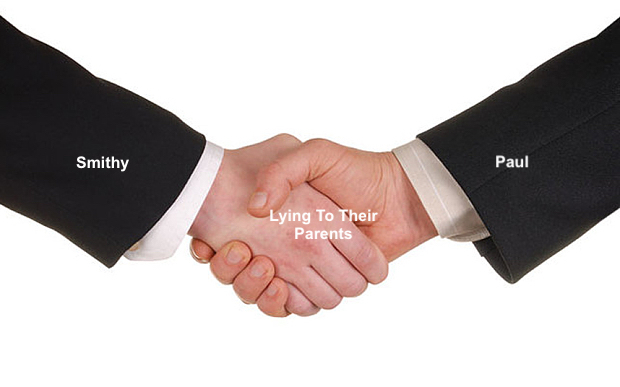
Jokes aside, though, I think this sequence with Smithy’s letter (and a great portion of the book) demonstrates a far more explicit disdain for Englishness than Paul ever expresses for German-ness. It’s explicitly jarring to hear Smithy put on a show of parodically English upper-class diction after hearing her real narrative voice. (This is another shared quality between All Quiet and Not So Quiet, and perhaps between more of the novels we’ll read this semester; the intimacy between the narrator and the audience, an intimacy that doesn’t include older authority figures in the narrator’s life.) And picking up from my very first item: what my writer friends and I refer to as “momblems” are a lot more bitter and pronounced for Smithy than they are from Paul. Paul lies to his mother with the primary intent of protection; Smithy feels an explicit (and justified) disdain for her.
39: Authority figures
“One of these days I will murder her slowly and reverently and very painfully. I will take lots of time over it–unless I meet her coming up the hill with dim lights, denoting an empty ambulance, in which case I will crash her bus head-on and take the risk of my own skidding into the valley afterwards.”
Two important points here. First, a quality of this book that I appreciate is that (even though one of the girls later says “It’s women who will end war,” a statement I find unconvincing in the light of the rest of the book) there is no essential quality of kindness or goodness ascribed to women by default here. The Commandant abuses her power and takes pleasure in doing so, not in the same ways but in many ways just as destructively as Himmelstoss does. Secondly: young women are just as capable of thinking murderous thoughts about their sadistic superior as young men. With the difference being, I guess, that Smithy and the gang cannot plausibly team up to beat up the Commandant. (Cannot, or choose not to, or both? Let’s debate violence again, I guess.)
45: Camaraderie
“A hot-water bottle? They have made a hot-water bottle for me. My friends! They have not forgotten me. This touch of kindliness finishes me completely. The tears roll down my cheeks. I feel a rotter… a beast. I have been calling them everything vile, and all the time they have done this for me.”
A parallel and a contrast in one: the sense of camaraderie between the young people in a horrible situation is the same, but the vital distinction is that Paul never has the moment of misdirected rage against his comrades that Smithy experiences on the preceding pages and feels horrible for upon discovering the hot-water bottle. I don’t like to express preferences here, but I there’s something more authentic about this particular take on experiences of comradeship in crisis; rather than a consistent flood of safety, Smithy’s informed sense of crisis functions in such a way that everyone is a potential threat to her, and in moments of real despair even the bonds of friendship can’t automatically beat out cold, hunger, and exhaustion. Of course, the two characters also exist in different situations; is it in some ways lonelier to be an ambulance driver than to be a soldier? I don’t think I’m qualified to say, having done neither.
55: Solutions?
“Enemies? Our enemies aren’t the Germans. Our enemies are the politicians we pay to keep us out of war and who are too damned inefficient to do their jobs properly. After two thousand years of civilization, this folly happens. It is time women took a hand. The men are failures… this war shows that. Women will be the ones to stop war, you’ll see. If they can’t do anything else, they can refuse to bring children into the world to be maimed and murdered when they grow big enough.”
The same sense of flirtations with internationalism that Paul and his comrades experience on the other side; the same blaming of authority. The gender theory is new, and given the actions and words of the Commandant and Smithy’s mother and the B.F., I’m not sure the text of Not So Quiet… is in accordance with Edwards’s statement here. I like that it’s brought up here, though, for contemplation–
– and I like most of all the way focusing in on any one echo between the two books brings up more questions than answers, and rarely leaves us with the ability to say “well, that’s a parallel!” and move on without further interrogation. So: if there’s anything I missed, or any parallels/contrasts/half-parallels that you discover in further chapters, or if you want to respond to any of the big themes listed above, that’d be (Smithy writing to her mother voice) really splendid!
Repetition of words to show emotion or give clear imagery in Not So Quiet…
As I started reading Not So Quiet, I noticed the repetition of certain words that Helen used to either show her emotion towards something or help build a clear image of something that she is explaining or describing. I am a bit ahead as far as the reading but so far, I have marked 8 different times up to chapter 5 that she has repeated words together to help the reader understand what is happening. I felt as though when I was reading the repetition helped me feel as like I was there and gave me a clear picture of what was happening and helped me connect more with Helen. I noted that the words were often repeated in 3’s.
Just to show a few explains:
“Number Five hospital” (page 12): this was repeated to show how tiring it is to continue returning back to the hospital, almost like going in a circle, ” It ended, just as I thought it would never end” (12) This is one of the first times in the book that we get a description of how Helen’s experience as an ambulance driver went during the war. Defiantly not a smooth job!
“Snip, snip, snip” (page 14-17): this was used to give the image on Tosh cutting her hair. This repetition (3 times each time mentioned) is used throughout three pages and gives the image of Tosh cutting her hair and how long it took her to finish. Along with this, the repetition allows us to be in Helen’s mind and gives us her opinion on short hair and it is the first reference to her mother’s beliefs, “Poor Mother, she would die of horror if I came home on leave with my hair cut short like a man’s” (15).
“Limp, limp, limp”(page 57): this was used to describe Edward’s husband not having one leg. Helen expressed that she would not want to marry someone like this because if not she would be like Edwards and, “She will never be able to forget these days and nights of war and horror”(57). I felt like although it was used to give an image of Edward’s husband, it allowed the reader to think about how Helen does not want to remember the war once it is over.
This is just something I noticed as I was reading and found it interesting and helpful as I got farther in the book.
Does All Quiet On The Western Front have the same impact today
In the 12:30 section on Tuesday we mentioned briefly how this book was banned in Germany during WW2 for being anti-German/unpatriotic, along with showing the realities of war. I have not been able to stop thinking about how this book is no longer banned, and I wonder if a new war with that type of atrocity started, would it be banned again? Do banned books work? I was wondering what your thoughts were on how we can read and see the realities of war and conditions and yet still create them? This book was published in 1929 and people who served in WW1 had to turn around and see their children and families serve in WW2. We have so much access to media today but back in the 1930’s I can’t imagine how the portrayals of the battlefields would have been accepted.
NOT SO QUIET Miscellany
Nellie notes that her family is sick of receiving her “crossed-out field postcards” (30). This is an example of such a card, many thousands of which were sent during the war:

Bovril: “thick and salty meat paste extract” (wikipedia)


British ambulance and drivers:


Postwar Facemasks: A Desperate Attempt to Comfort Veterans
In the 2:00 section today, we briefly discussed the popularity of masks for soldiers who suffered facial injuries as a result of numerous traumas in the Great War. From what I could gather based on my research, it was a relatively small but very impactful field. Soldiers faced a long journey after an injury as new medical techniques resulted in higher survival rates, but survival could come with severe scarring. While medical techniques were improving, they were far behind where we are today and the facial reconstruction field aced constant challenges when treating soldiers. Previously, the field was almost exclusively focused on returning function and form to soldiers’ faces with little focus on appearance. Sir Harold Gillies became a leader in the field of facial reconstruction as he was among the first to put an emphasis on the aesthetic portion of plastic surgery for soldiers by working with artists to imitate a man’s face before his injury. While his work was revolutionary for the time and he made a significant impact, he was limited in how much he could do for a patient. As writer Allison C. Meier puts it “medicine had not caught up to the advancements of war,” which I found to be an incredibly interesting comment on how war disrupts normal life and catches everyone, in every line of work, off guard and forces them to adjust accordingly.
Because of these medical limitations, artists began creating masks for soldiers with facial deformities to help them cope with life after the war. A facial disfigurement was considered the most traumatic result of service during the war and, as one can image, there were a great deal of psychological factors accompanying it. The Masks for Facial Disfigurement Department was created by Francis Derwent Wood, an artist who wanted to help patients he met while working as an orderly at the 3rd London General Hospital. His work consisted of metallic masks, modeled to resemble a soldier’s face before injury, were designed to be lighter and more permanent than the rubber prosthetics. Wood believed his masks could offer the same psychological benefits as plastic surgery for those veterans whose injuries were too severe for surgery because they had an opportunity to regain their confidence. Wood was followed by Anna Ladd, who spoke with Wood and went onto open a Studio for Portrait Masks in Paris; Ladd had even more successful artistic results than Wood. Tremendous effort went into these masks by both Wood and Ladd’s teams as one mask could take a month to make. Ladd created hand-painted copper masks, with a process beginning with a plaster cast being taken and slowly transformed into a thin mask weighing between four and nine ounces(depending on if the mask covered half or all of a patient’s face) held in place by spectacles. Some of Ladd’s most famous techniques are painting the mask while a man was wearing it so she could get as close to his skin color as possible and using real hair to create details like eyebrows, eyelashes, and mustaches. Ladd created 185 masks, and while there is not specific number, one can assume Wood created even more as his department was open longer and his masks did not take as long to make; unfortunately, their impressive work does not even come close to treating all facial injuries suffered in the war. While a mask could not restore function or allow for expression, soldiers expressed immense gratitude for the comfort they found in hiding their injuries. The masks created by both Wood and Ladd represent society’s attempt to recover from the the Great War; people did not want to look directly at the cost of war and the men who actually fought did not want their reflections to be a constant reminder of the horror. My summary does not even come close to providing all the information on this, but I hope this gives a little more background on it for some people! If you are interested in looking into it further, there are a lot of great articles on the topics, starting with the ones I cite below.
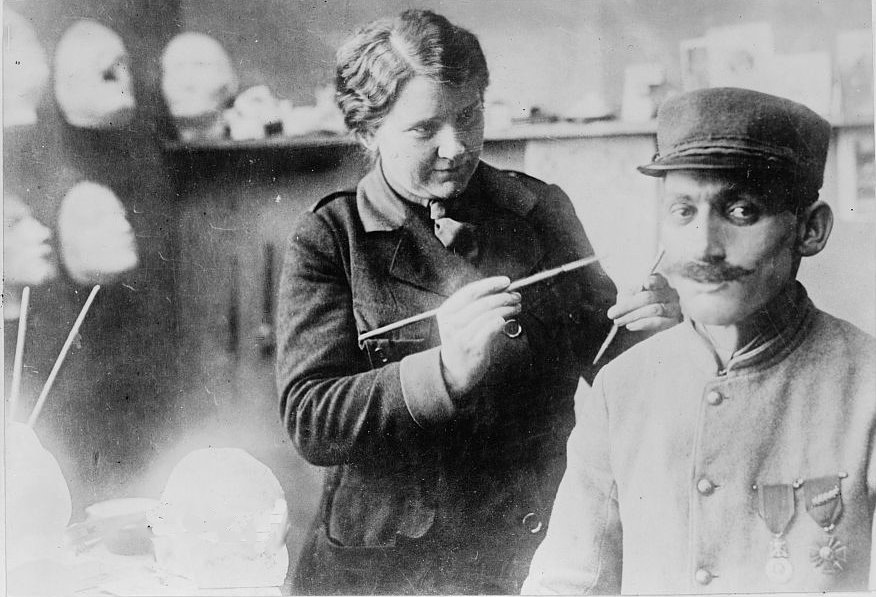
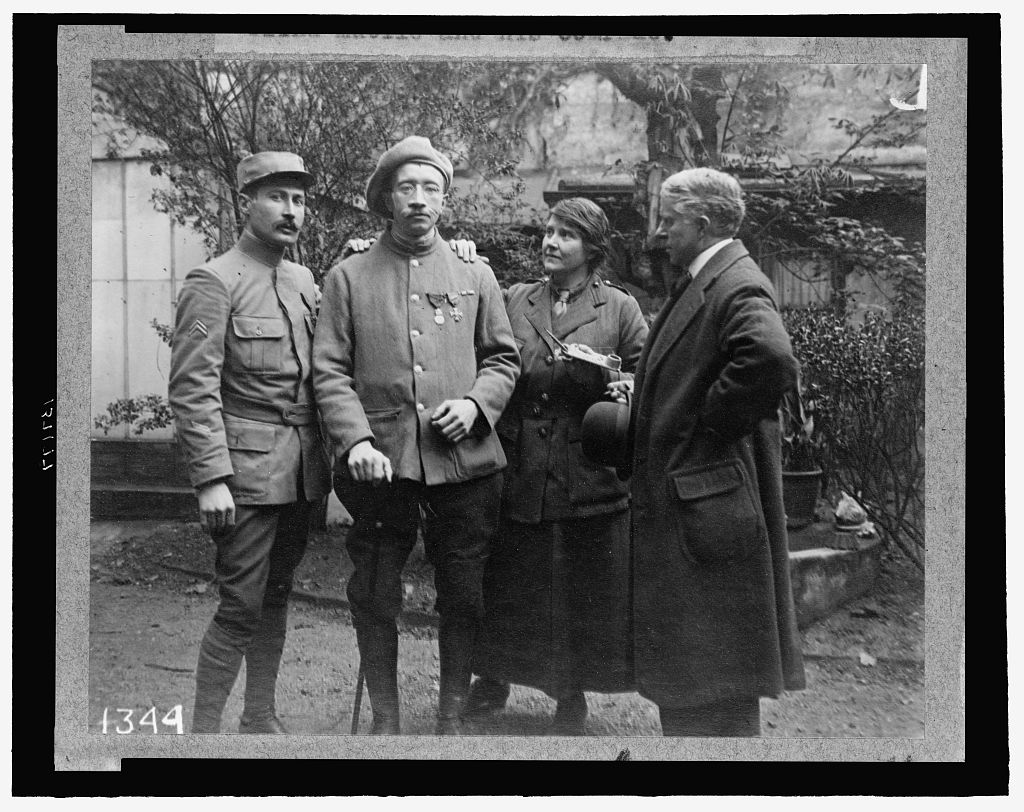
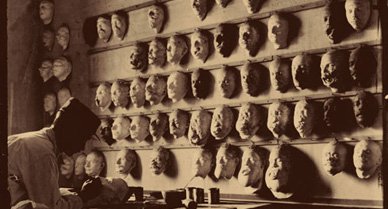
P.S. My rabbit hole on this topic started because Dr. Scanlon’s description of the masks made me think of Phantom of the Opera and I wanted to know if there was an relation between the two as I was uncertain of when Phantom was first written. Phantom of the Opera was written in 1925, so about 7-8 years after Wood and Ladd produced face masks for wounded soldiers. The idea of the phantom’s mask hiding something terrifying is a sad context to view the reception of the masks in as it is further proof the wounded could never really fit back into society and probably faced the same feelings of societal exile as the phantom does.
Works Cited
Alexander, Caroline. “Faces of War.” Smithsonian.com, Smithsonian Institution, 1 Feb. 2007, https://www.smithsonianmag.com/arts-culture/faces-of-war-145799854/.
Meier, Allison. “How Masks of Mutilated WWI Soldiers Haunted Postwar Culture.” JSTOR Daily, JSTOR, 19 Nov. 2018, https://daily.jstor.org/how-masks-of-mutilated-wwi-soldiers-haunted-postwar-culture/.
Not So Quiet is a Silent Scream

The first time I read Not So Quiet it was quite a shock. The portion of the text assigned for this Thursday 1/27 makes several excellent points about the hardships British VAD (Volunteer Aid Detachment) nurses had to endure. While the work is fiction, Smith, who’s real name was Evadne Price, does not shy away from drawing on the emotional whirlwind that wartime nurses experienced. Price, an Australian who served in the Air Ministry from 1917-1918 expresses visceral and tragic feelings about the war in her prose.
Price’s use of nicknames for the various nurses is an excellent way of making her characters accessible as well as somewhat likable, with the exception of Mrs. B—-, of course! One of the best aspects of this work is its candor. The work opens with references to the food shortages, biting cold, and chronic sleep depravation. The portions about lice and the filth the nurses must deal with are shocking but rigorously authentic.
One of the most engaging things about Not So Quiet is how Price writes with such raw emotion. She is not afraid to tap into the hatred the protagonist feels for her parents and those at home in England who have no idea about the extent of human suffering happening just across the Channel. Helen’s resentment and anger over the harsh conditions is also something the author is very comfortable divulging to the reader.
Did the nature of Not So Quiet surprise you? Where you expecting something very different? What do you think about it so far?
Lord of the Flies-esque?
Something about All Quiet on the Western Front reminds me of my first time reading Lord of the Flies by William Golding. (I read it five years ago, it is definitely a little blurry!) Golding’s story revolves around a group of young boys who have crash-landed on a deserted island and must learn to regulate themselves. I believe that I draw parallels between these two novels because they both invite the reader into a world where there is a lack of societal expectations, no set rules, and limited ethical standards. The Great War was the first experience of soldiers in horrendous conditions (trench warfare, updated technology, mass killings) where there were no set guidelines to follow. Due to inconceivable circumstances, this war was quite different from those of the past. I am not referring to all the soldiers fighting, particularly those on the Western Front. There, soldiers of all nationalities were forced to suffer for years on end with little, if any, relief. As we discussed in class, men on the front began to assume more maternal roles, ones that would be deemed emasculating were they at home. Comforting fellow soldiers, expressing vulnerabilities, and intimate friendships would all be inappropriate within society. However, due to their secluded position, the men on the front developed a new sense of societal expectations. The same can be said for their lack of decorum. They sit on latrines for hours, keeping one another company. When relating it to regular times, Paul says, “There it can only be hygienic; here it is beautiful” (Remarque 9). The rules established on the Western Front are different because they have had to adapt to a new reality. They eat rats, masturbate together, and beat each other up to keep from traumatic attempts at suicide. As in Lord of the Flies, a different set of rules is necessary because of their location.
Possibly the largest connection I make between the two is their change in moral standards. When a young recruit is suffering from what is indisputably a long descent into death, the characters debate killing him. To many, that is considered murder (which is illegal.) However, these soldiers have seen the pain that a death like this will produce, and their ethical scale is tipped in a direction not aligned with modern society. It is their experience and knowledge that leads to this interesting dilemma. Their sole intent is to fight and survive, and to some, that puts their sanity into question. In the second chapter, when Muller asks after the boots of a man not yet dead, it is considered realistic on the front, but would be appalling to anyone else. These sort of decisions are unique to those who have undergone this same experience. All Quiet on the Western Front may not follow the same story line as Golding’s book, and it doesn’t have the same disturbing actions, but they do both pose a compelling question: what would you do to survive when you are separated from the rest of the world?