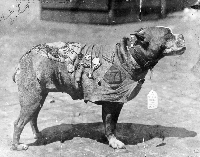
As briefly mentioned in class today, there were many different types of animals that served in World War I and World War II. Animals such as horses, pigeons, dogs, and cats. Stubby was an infamous dog that served in World War I. He did many brave acts while at the front, from warning the soldiers about a gas attack, to finding a German spy while investigating American troops. But most importantly, he provided moral support for the American troops in the war.
This is a picture of Stubby at the front lines
I will add a link to a website that talks more about Stubby. His story really is amazing. What he did during and even after the war was absolutely inspiring and even hilarious.
1. Borden expresses disdain and criticism for her work several times in this section, especially in “Rosa,” in which they attempt heal a man who attempted suicide even though he will subsequently be court-martialed and killed, “Conspiracy,” in which they “mend” soldiers and send them back to the front repeatedly until they finally die and “conspire against his right to die” by performing surgeries (80), and in “In the Operating Room,” in which surgeons ignore and dehumanize patients. How do you think Borden perceives her job, and how does she resist or conform to it?
2. In “Paraphernalia,” Borden uses the second person, speaking to an unclear “you.” Who do you think she is addressing, and to what effect? How does she perceive this “you” character?
3. In these stories, Borden often uses animal imagery. The soldier in “Rosa” is compared to an ox, beast, and dog (63-66, 69), Borden refers to a possible new race of men having hatched “like newts, slugs, larvae of water beetles” in “The City in the Desert” (74-75), a patient is called an “animal” in “In the Operating Room” (86), and in “Conspiracy,” Borden feeds a “helpless” soldier to “fatten him up,” which is language that suggests a helpless animal fattened for slaughter (81). What is the purpose of this imagery, and what effect does it have?
In Borden’s Fragment titled Moonlight, she lists three companions on page 40, “Pain, Life and Death.” She then spends the next six pages describing what Pain does and how Pain infects her daily life and those around her. “Pain is the stronger. She is the greater. She is insatiable, greedy, vilely amorous, lustful, obscene.” She gives Pain feminine pronouns, calling it she/her/hers. What does making “pain” feminine add or take away from the story? In all of the literature we have read so far, what else is described with feminine pronouns and how does that connect to Borden’s idea of a feminine Pain?
Borden writes for the people who did not serve in the Great War, then and now. This includes us as a class. If this was the only book we had to study, the only book that came out of The Great War, would your feelings about the war change? Would your understanding of the war change? What understandings have we gained through our other texts that are missing from The Forbidden Zone? What ideas are present here that we have not seen anywhere else?
Similar to “The Beach,” Borden on multiple occasions has “zoomed out” of the story she is telling. Physically she seems to be so far away that people turn into “flies on the beach (p37),” and “ant people (p13).” These fragments she is sharing with us are all supposed to be moments she has witnessed herself, but clearly she is not a giant or watching from an airplane. Why does she repeatedly stay far away from the narrative she is sharing?
She looked round her as if to find the man he once had been. There were other women on the beach, women in black and old men and children with buckets and spades, people of the town. They seemed to be glad to be alive. No one seemed to be thinking of the war
Throughout this semester we have seen many instances in which “no one seemed to be thinking of the war”, however, in this short story we also get the statement, “They seemed to be glad to be alive”. Why has the author chosen to use the phrase of ‘seeming’ to be something with reference to the effects of war? And do you think the wounded man is “glad to be alive”?
Moonlight:
Within this story, we are presented with many images and details regarding the comfortability with the ‘Pain’ and suffering of war. For example, the narrator constantly reminds us of her hatred for the smell of freshly mown hay despite her love for the smell of the mud and blood. Do you think this is simply a case of ‘being used to it’ or is there something deeper being said?
Rosa:
In this story we hear of a physically strong man who attempted suicide, but survived a shot to the head. After his initial survival, we learn of the fact that he will be court marshalled and then shot dead for his attempt. We have seen in other texts this semester how making an example of someone mattered more than their life itself, what are your opinions on this and how do you think it impacted the war?
I was writing my short essay and looked at Hemingway’s unwritten endings. He almost wrote “…you have to stop a story. You stop it at the end of whatever it is you were writing about.” This may not be the highest degree of textual analysis, but to me this answers with extreme clarity what exactly Hemingway was writing about. Or at least what he meant to write about, even if he ended up with a highly regarded war novel. His story ended when Catherine died, and Henry and Catherine ended. What else could he have been writing about?
Anyways, I just wanted to share that quote with y’all and see if it impacted the way anyone else might see A Farewell to Arms – also if anyone thinks it may be neither? I think the question is often a love story OR a war story, and I certainly don’t think this is a war story, but it doesn’t feel so much like a love story to me either. I can’t think of better label though – anyone got anything?
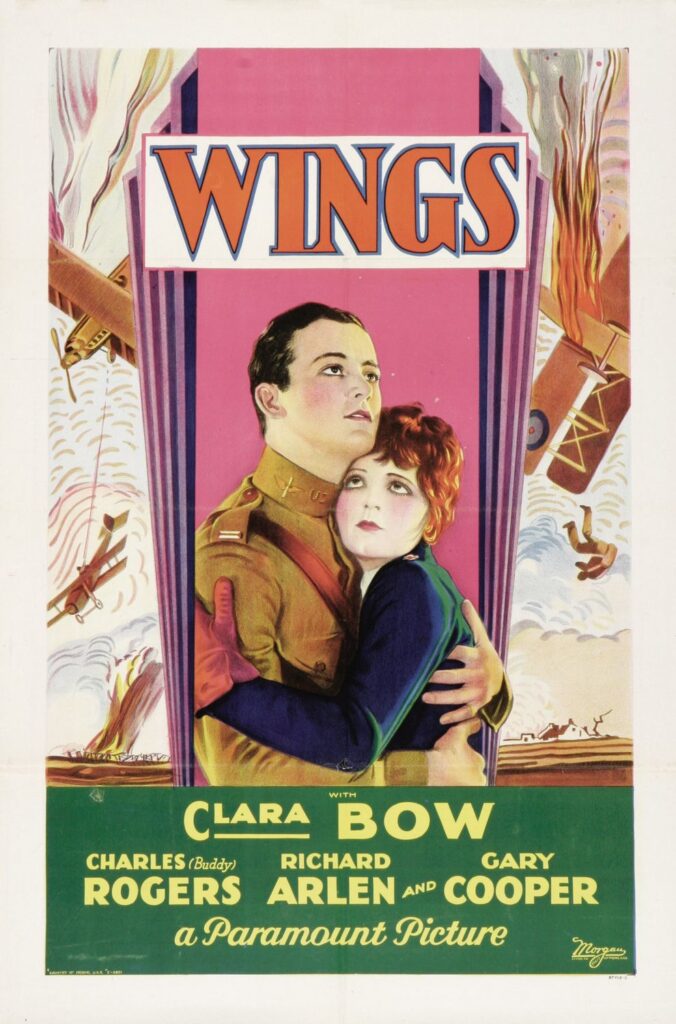
“To those young warriors of the sky, whose wings are folded about them forever, this picture is reverently dedicated.” – Last line of the opening prelude to “Wings“
Filmed in the span of just nine months, Wings is a 1927 American film (although it wasn’t actually released in the U.S. until 1929), directed by former WWI aviator, William A. Wellman, and starring Richard Arlen (also a former aviator in the War), Charles Rogers, and Clara Bow—Paramount’s bona fide ‘IT Girl’ and star with a big, glittery capital ‘S’.
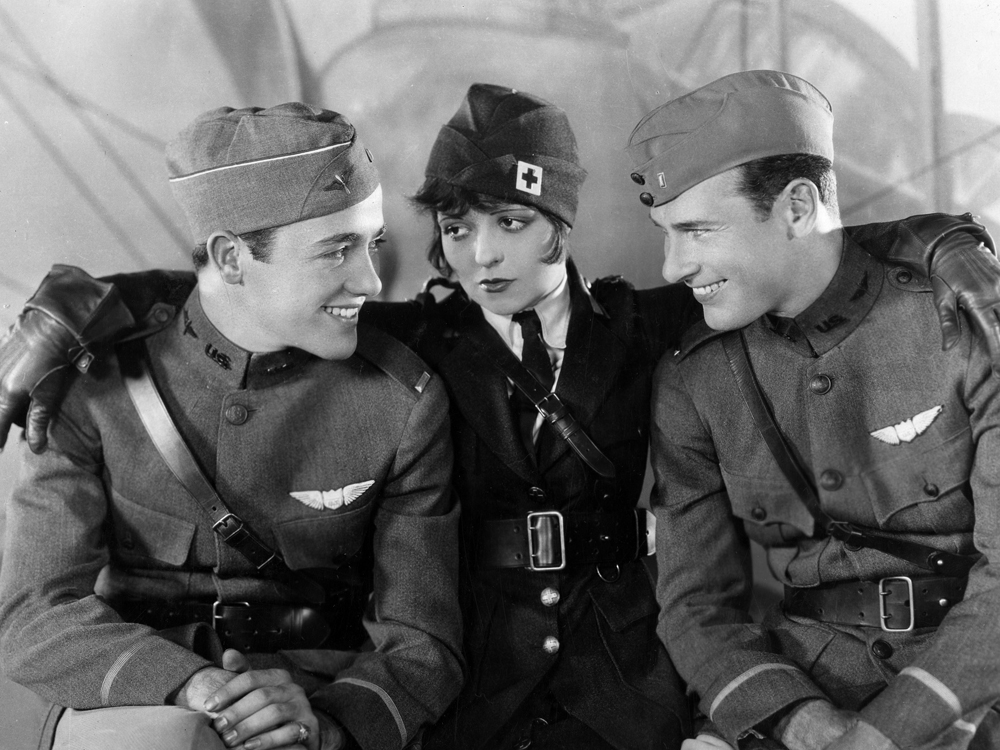
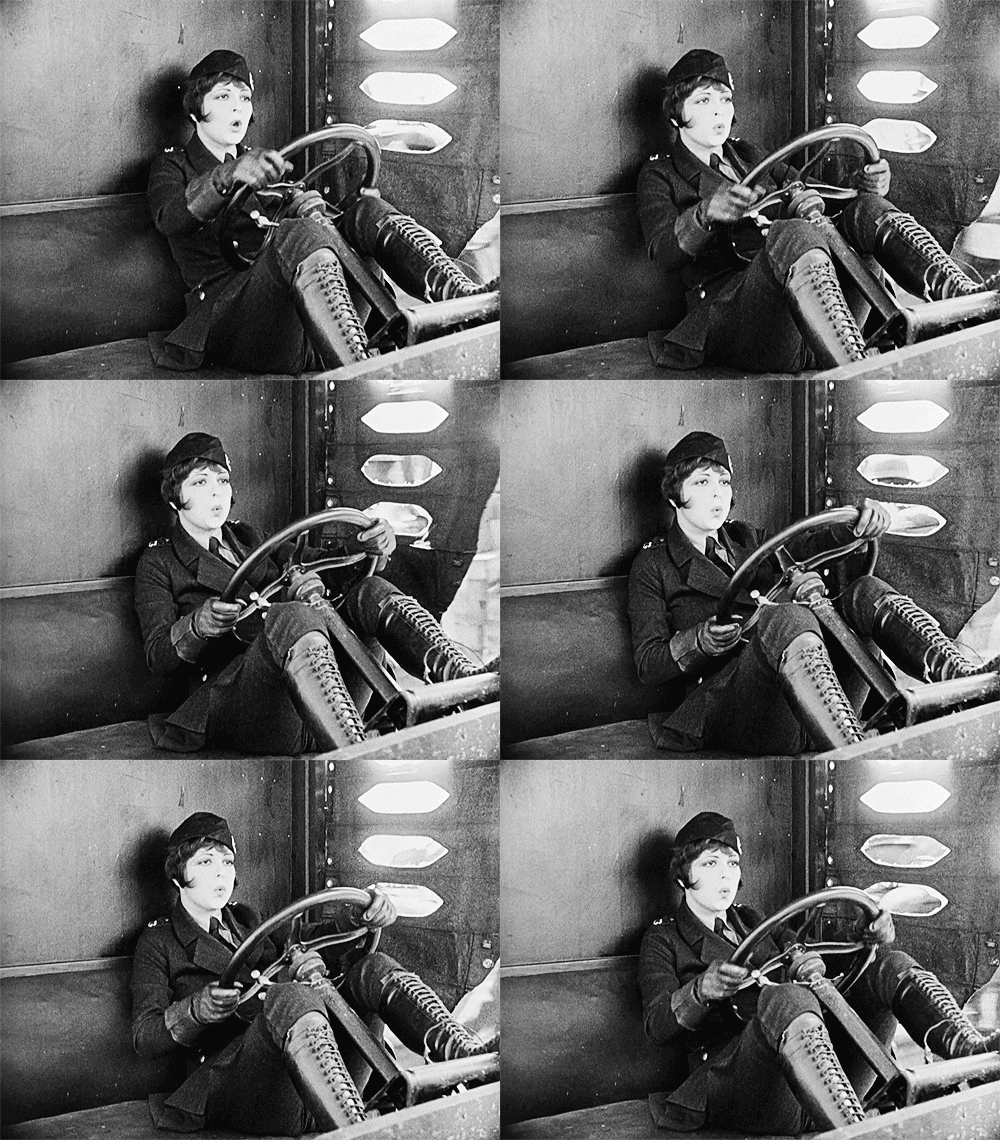
The film is a romantic war drama, telling the story of two men: Jack Powell (Rogers) and David Armstrong (Arlen). Both men are from notably different walks of life: Jack is a middle class idealist with a dream of flying, while David is the son of the richest family in town and seems far more down to earth—really, the only thing the boys have in common outside of their decision to enlist in the War is their rivalry for the affections of the beautiful city girl, Sylvia Lewis (Jobyna Ralston). Meanwhile, Jack is painfully oblivious to the affections thrown his way by his friend and literal girl next door, spunky and doe-eyed Mary Preston (Bow). As 1917 closes in, both Jack and David enlist in the army to become aviator pilots and are billeted together and, following the sudden death of their tentmate and having undergone intense military training together, the two’s rivalry fizzles out into the gritty but affectionate friendship that sometimes borders on intimate as the war drags on, a relationship which feels all too familiar and tragic in this class. Meanwhile, Mary decides to enlist in the Women’s Motor Corps of America as an ambulance driver—and well…fate finds a way.
Jack (Rogers), Mary (Bow), and David (Arlen)
This film initially caught my attention on two factors: 1) it was just barely before All Quiet at the Western Front in the US (and completed two years prior), and I was curious on its portrayal of the War—would it condemn it or glamorize it, in its retrospective approach?; and 2) as a silent film (sans the music cues and SEX added in the 2012 restoration by Paramount), it mostly relies pretty much solely the expressions and body language of the actors alongside the cinematography to tell its story, as you can’t just type out every little line of the script on title cards and call it a day. Considering how much we have read in class from the POVs of characters who have mostly internalized everything to the point of coming off as notably detached, could the exaggerated and expressive style that is practically necessary for silent films work in a film about the Great War? Thankfully, both of these questions were answered in a way that I felt was satisfying.
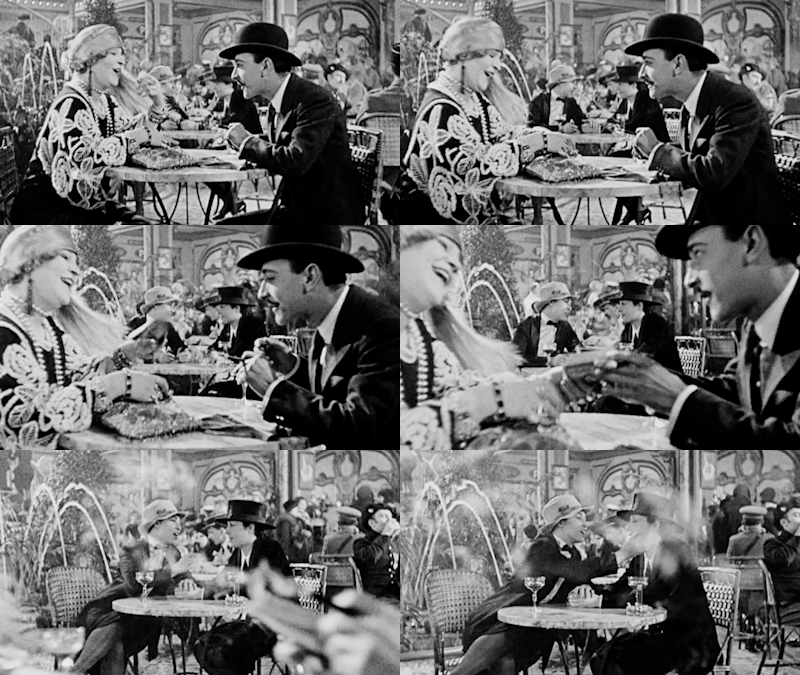
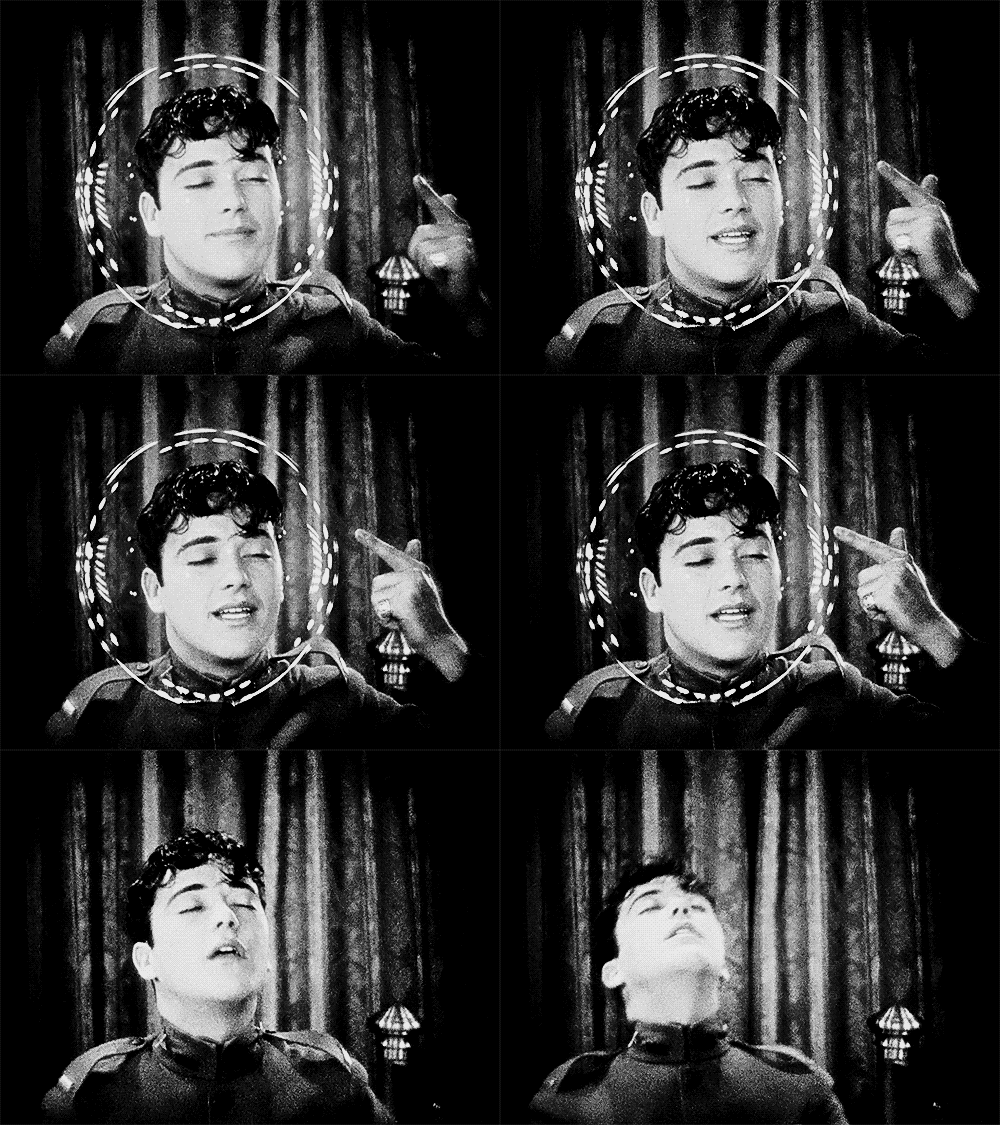
Right off the bat, the cinematography is nothing to scoff at: even a shot as simple as David and Sylvie lazily swinging in a hammock together is poignant as the camera literally swings along with them, back and forth, before the sudden arrival of an excited Jack literally jolts their idyllic scene to an abrupt halt. Likewise, there’s an equally stunning dolly zoom later on in the film in which we glide past all the gleeful patrons of a French nightclub drinking and petting before we land on a happy and shamelessly intoxicated Jack. However, the moments that will surely stand out—even in the somewhat drag of a first act—are the aviation and dogfighting scenes, among the first of their kind, and just as enthralling today as they were almost a hundred years ago. Additionally, there are little animations added here and there such as the bubbles that occupy Jack’s hazy mind during his drunk stint on leave in Paris halfway through the film, as well as in the title cards, that are a nice touch.
Many of the texts we’ve read have emphasized the dangers of individuality and how people were stripped of it during the War—here, we have a clearly defined protagonist in the primary POV character, naive Jack Powell. Moreover, the film early on, almost takes on the jovial, patriotic tone that one would more likely see on propaganda posters than on the actual Front; much lime we have a clearly defined “hero”, we have our established villain: German ace pilot Count von Kellermann and his dreaded “Flying Circus” who, among ominous closes ups of the Iron Crosses on their black planes and shots of the pilots giggling and twirling their mustaches as they bomb compounds with glee, are accompanied by a score that seems more suitable for a Star Wars villain. Likewise, the emphasis on comradery amongst the Allied forces is paramount—the British soldiers gleefully rescue Jack went he’s down and cornered by German gunfire, eagerly ushering him into their trench with wide smiles on their faces—”chivalry of the knights of air”, the movie calls it. There’s even a comic relief character, a Dutchman named Herman Schwimpf, whose entire schtick is that he is blissfully and shamelessly patriotic to the point of getting an American flag tattooed on his bicep to wave as his superiors continuously try and fail to literally knock sense into him.
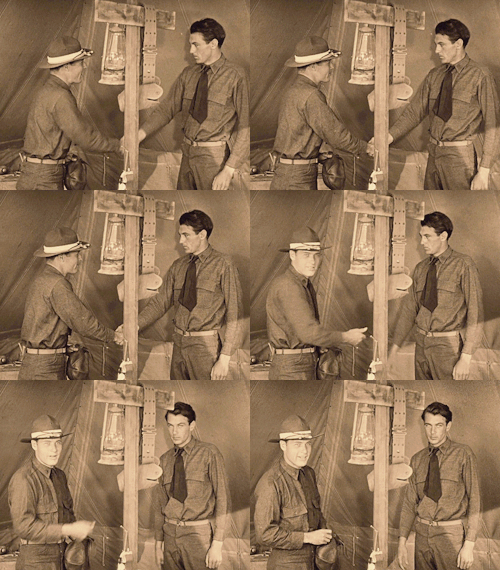
Gary Cooper, in his film debut, as “Cadet White”
Yet, despite the somewhat light tone starting out, there are notable undercurrents of things not being so great about the Great War: kicking off with the almost immediate and senseless death of Jack and David’s would-be tentmate, Cadet White, before we even have the chance to get attached. Likewise, a fairly comedic scene of Jack’s fun drunk antics in Paris and Mary’s attempts to get him to leave with her to get him back to his post (and away from the French girl he’s been cozy with) is under the threat of him being court martialed, and ends with the painful double whammy of Mary both realizing Jack is in love with Sylvia and then being fired from her job when military police catch her undressing from a gown she used to infiltrate the nightclub, and assume the worst.
“Here, for men fresh from the front, whose minds carried the image of unutterable horrors—here was forgetfulness…”
It all goes downhill following her abrupt exit, as we are thrown headfirst into the War again with scenes that are, while not very explicitly bloody, are just as intense—from a random soldier getting struck down with shrapnel from a bombing in the Front, to another soldier being crushed by a falling tank, its made abundantly clear that this film, while a romance, is anything but romantic down to its roots. When Jack and David’s relationship gets tested following a misunderstanding, and David is later shot down by the enemy in the following dogfight, Jack makes it a point to brand himself the hero and avenge his fallen friend by taking down as many Germans as he can. Little does he know, David is still alive in German territory, and manages to escape by stealing a German plane. Oh, oh no…
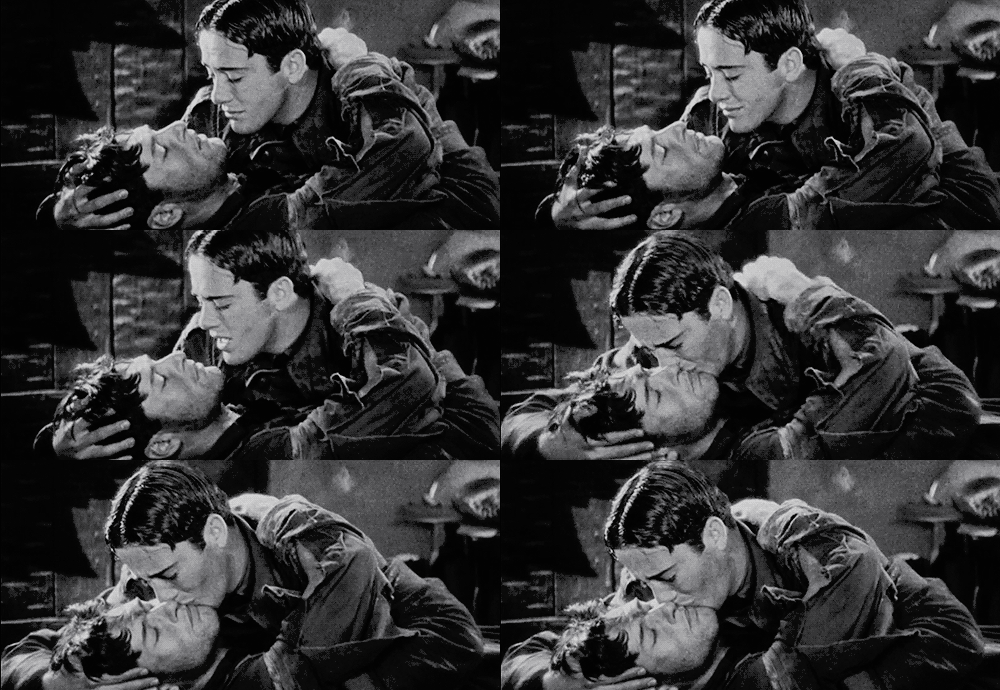
The film was also one of the first to show a same-sex kiss onscreen
Jack’s stint at heroism ends with a sharp role reversal as he is given tube villainous music cues as he tries to chase and strike down David, believing he’s “only another foe to be slaughtered without mercy”. When he eventually succeeds, he’s finally broken when he realizes his fatal mistake, much like Paul and the French soldier, only this time, he has a grieving family he has to go back to. Rogers and Arlen’s acting in this scene is excellent, and we even cross that blurred line of the friend, brother, and the lover so common in the bonds between soldiers at the time, leading up to arguably the most famed scene of the film nowadays: Jack passionately kissing David on the lips as the latter dies in his arms. And although Jack goes home a celebrated “hero” (to the point of literally having his name and face plastered on newspapers that laud him as such) and is publically showered with adoration and flowery parade rides through town, there’s a distinct emptiness as he looks at the little bear charm David left behind—the one Jack promised to return to his mother. Furthermore, the ending scene between Jack and David’s mother makes the message obvious: “I—I wanted to hate you, John, but I can’t. It wasn’t your fault. It was—war!”
Overall, I really enjoyed this film despite its slow start, and would recommend it even if you don’t like silent films. The acting and the action is excellent, and it really feels like gradually watching characters like Paul get to the point of where they were in their story fresh from their idealistic beginnings—under a less overly violent, nihilistic lens. I can see why this won the Academy Award for Best Picture. My only real complaint is that Mary did NOT deserve Jack—at all.
Joyeux Noel, made in 2005 directed by Christian Carion, is a French film capturing an accurate portrayal of various places along the front. Based on the true story about the Christmas truce of December 1914, Joyeux Noel is filmed from the perspectives of three different regiments, the Scottish, the French and the Germans. Throughout the film we hear actors speaking in German, English, French and even Latin during a religious ceremony. The actors all portray a character of their nationality, which adds another dimension to the character. This added level brings more realism to the film and to the situation, deepening the viewers empathy and emotional reaction. A key component of any war film is a question of the accuracy, and in this case the directors stayed very true to the events as well as utilizing letters and other reports supporting the film’s portrayal.
From the war being announced and boys being excited to participate, to the constant distant sounds of bombings and the sights of flare, this movie was meticulously researched. The film depicted the Christmas trees being sent to the German front lines, as well as the opera singer sent for entertainment by the Crown German Prince Wilhelm; though there were some creative liberties taken to add a romantic element to the film, the storyline stays accurate to true events. Since this is the beginning of the war, gas masks were not needed yet and most of the front may have not yet experienced the mass casualties that became more common as the war progressed. This is one of the reasons why truces were even possible at this time. Another heavily researched aspect of the film was the set. The set designer looked into weapons, uniforms, food, structure of trenches, and even into a depiction of a Latin mass. Of the few inaccuracies I could see, some are regarding the trenches as in the movie, the trench is not packed with men and we don’t see men displaying any signs of trench foot, a common occurrence due to never being able to get out of the mud and muck of the trenches. However, we do see men having lice, and large rats taking over the trenches. We also see wounded men being left overnight in no man’s land groaning and begging for help, like we read about in All Quiet.
Adding to the dramatic element and the human effect, all three leading Lieutenant characters were all written to be similar to each other. Something I found relevant to not just the characters but also the accuracy of the time and film was that all three could speak some or were fluent in the other’s languages. The German lieutenant spoke French and English fluently, and even spoke of how his wife was French and he would often visit the village where the French Lieutenant is from. These conversations helped to humanize the characters and show how it truly was a fight among the lower classes.
We have discussed this concept in class, how it was the lower classes actually fighting in the war and the upper class sending orders from afar, not truly understanding the brutality and cruelty of war at the front. A French lieutenant says, “You’re not living the same war as me,” to his superior officer after the Truce, and this quote sums up the separation between soldiers on the front and officers hiding in offices. During the Christmas Truce, we see soldiers meeting soldiers and building connections. Soldiers who don’t want to continue fighting, and wonder why they are fighting in the first place. They have seen death and have lived through miserable conditions since the start of the war and miss their wives. In Joyeux Noel, the soldiers have a difficult time restarting the fight after their truce and each regiment gets relocated or broken up and sent to different stations on the front due to their actions.
The biggest inconsistency I found was a female opera singer joining her husband at the front, so I surmise it was added just for the romantic element and a plot driver. A female being at the front in the trenches, and sleeping overnight, doesn’t seem historically accurate from the work we have uncovered in class. Another inaccuracy was that at one point the troops took turns shielding the opposition in their own trenches from an air-raid, I was not able to find research or letters to support this action.
The film ends with the German troops singing a song that they learned from the Scottish Soldiers, a song called Hymne des Fraternises (also known as I’m dreaming of home). The lyric, “I’m dreaming of home, I feel so alone,” captures a serious moment in the film surrounding fraternization with the “enemy”. What started as cheering and recognition with universally known songs through the trenches, lead them to meeting on no mans land and learning about each other. In the end, all of them were dreaming of home, and they realized they actually were not so alone.
Battalion (2015) is a historical Russian war film set in part at home before the latter part takes place at the front line. It was written by Ilya Avramenko, Evgeniy Ayzikovich, and Dmitriy Meskhlev and was also directed by Meskhlev. The film won awards for it’s music score, film editing, and Mariya Kozhevnikova’s performance as a supporting actress (IMBD). The movie follows the first Russian Women’s Battalion of Death which was formed as a part of a propaganda ploy to boost the morale of the men who abandoned their posts at the front line.
The plot of Battalion was very ambitious and rich. To attempt to record and retell a part of history that is involved in conversations on gender, politics, class, and how other social norms are disrupted during the course of war is quite the feat. To add to that, the heavy amount of characters and backstories they tried to cover often had me lost and scrambling to find out who was who and what was important or motivating to each of them. The film did a good job of keeping track at the start of the film when many of the women are introduced at enlistment, however as the plot developed it was a struggle to feel close to these characters and some of their deaths. The plot also attempted to move on plot points that felt odd and out of place. One such instance was the few minutes of domestic abuse and the graphic portrayal of (I wont say who for the sake of spoilers) that felt so unnecessary when such a struggle could have been mentioned more simply through dialogue. Even with a little over two hours of screen time, the ending felt abrupt and the story choppy as there were many moving pieces that seemed to just drop midair.
The actors of the film did a good job at portraying their characters in a manner that felt plausible and believable even in extreme plot points. Most notably the commander of the Women’s Battalion; of whom is hardened by years of battle and now leading a battalion of her own. At the face of death and the deaths of the women she is leading, her despair and guilt weighs heavy and translates clearly through the screen. On the other hand, as mentioned previously, the amount of men and women were so many that it felt as if they fought for dialogue and screen time to relate each’s own seemingly important subplots. I felt as if some actors’ performances felt forced and theatrical; such as the moments from the general office.
The cinematography of the film was beautifully shot to include broad moments of architecture and solid pieces of the setting both at home and at war to ground the viewer. However, technical elements such as camera angles, blurring, and close up moments at times felt inappropriate. In one moment of the film, on the front line, the camera bounced up and down in the face of one of the woman soldiers in a manner that felt awkward and jarring. In other instances, a blurred camera view can effectively and intimately draw the viewer to a vague understanding of how your vision could be obstructed during a gas attack or faulty after an injury to the head. The musical score, on the other hand, effectively boosted the film and its moments of anticipation and relief; whether the relief was to be false or true.
Overall, the film Battalion was a movie that tried to do many different things, but did not have enough time to properly and effectively cover such elements. Such conventions and themes were; political motivations, the psychological effects of war, womanhood vs. manhood, and how normalizing judgment works within that space. As a result, the message felt very rushed and difficult to keep up with. I would have loved to explore more why the soldiers abandoned the front line and ultimately why they decided to take the course of action that they did at the end of the film. I would have also loved to see how loss of self functioned within sexuality more developed in the movie as it was only mentioned in passing a few times. However, I would recommend Battalion as it is a movie that does capture a unique piece of Russia’s history that I would have otherwise been ignorant to if I did not have the honor to watch the film.
Based on the 1938 novel of the same name written by Dalton Trumbo, Johnny Got His Gun is an anti-war film directed by Trumbo himself in 19711. Johnny Got His Gun details the experiences of a young, fictional soldier named Joe Bonham (Timothy Bottoms) who was seriously injured on the very last day of World War I. With this tragedy, for Joe, comes confusion, despair and several startling realizations as time goes on. At some points, things start to look up for Joe, only for those dreams to seemingly end as quickly as they began.
Johnny Got His Gun provides a harrowing depiction of not only the emotional harm that can result from war, but the physical harm as well and the possible consequences of each. In Joe’s case, his emotional harm seems to largely stem from his physical harm and the poor attempts made by the medical team that attends to Joe to regard him as conscious and feeling. Due to the severity of his injuries, Joe is made to be entirely dependent on near-constant medical care and attention. On a darker note, the medical staff where Joe is being taken care of do not understand Joe’s inner thoughts, as he is unable to verbally communicate and initially does not even understand what has happened to him. It felt as if with Joe’s vast physical injuries, his humanity was stripped away from him by others’ lack of true understanding and compassion, leading to the tragic ill-treatment of his injuries as a whole.
As for the stylistic choices in the film itself, when the scenes are centered in Joe’s present-day reality (post-injury), the scenes are shot in black and white. Joe’s lines are not delivered by him verbally, but rather through the style of Joe acting as a narrator for his own internal monologue. For the majority of the present-day scenes, Joe is able to broadcast his thoughts to viewers of the film, but not to those around him. On the other hand, when the scenes are focusing on Joe’s memories and dreams/imagination (pre-injury or free of injury), they are shot in color. This felt like a really interesting stylistic choice for this movie and worked effectively to distinguish the “settings” (so to speak) of the film and set the tone for each one respectively. The black and white scenes reflected Joe’s somber, solitary reality, while the color scenes seemed to be more hopeful for Joe, and frequently less bleak than the present-day.
Bottoms’ performance as Joe complemented the film nicely, even though there were moments that may not have felt as emotionally convincing as others. This minor complaint, however, does not really seem to impact the overall quality of the film. There are several (I mean several) emotional pockets dropped in throughout the film in which Bottoms offers up strong thoughts and feelings with his role as Joe. These pockets were often joined up with the performances of pivotal characters in Joe’s story, such as his father (Jason Robards), his girlfriend Kareen (Kathy Fields), and the smallest nurse that attends to him (Diane Varsi).
Overall, the film’s story had good pacing and although there were many switches between the present-day and Joe’s memories and dreams/imagination and his and others’ fluctuating emotional states, it was not a challenge to keep up with. Even if the acting could be more convincing at some points, the story and performances still managed to conjure up some strong emotions for me. Minor criticisms aside, Johnny Got His Gun was ultimately heart-wrenching to watch and provided a lot to reflect upon.
Directed by Peter Weir and released in 1981, Gallipoli follows the journey of two young Australian men, Archy and Frank, in their quest to do their bit for their country. The film opens with young Archy Hamilton (18) training with his uncle for the 100-meter run. Archy is said to be the fastest kid in Western Australia and is going to compete in his first race in a few days.
The night before the race, Archy’s uncle reads the story of Mowgli from the Jungle Book to Archy’s younger relatives. Mowgli’s character represents a coming of age story which foreshadows the same loss of innocence Archy is to experience. This indeed comes true as Archy ends up leaving his uncle after winning the race to join up. Originally, Archy is rejected from the Light Horse in his hometown (the company Archy is trying to fight with) for being underage. This is when Archy meets his new mate Frank Dunne who at first provides a stark contrast to Archy’s character as he does not see the point in joining up as it is “England’s war.” However, after enough societal pressure from Archy and others, Frank decides to join too. The two travel together to Frank’s hometown of Perth in order to try and join the Light Horse again. Archy succeeds, but Frank is rejected because he cannot get his horse to move. The two are eventually reunited in Egypt at training camp as Frank joins up in the infantry. The two spend weeks there training and building relationships with other comrades such as Snowy, Barney, and Bill. Soon after, Archy and Dunne’s companies are sent to Gallipoli, a peninsula in Turkey.
Here, the Anzacs (Australians and New Zealanders) and English are fighting to overtake Turkish resistance over the Dardanelles and Bosporus channels which Churchill (English Lord of the Admiralty) thought were vital to supply Russia with ammunitions. The fighting is brutal and the Turkish soldiers have a much better position. In a last ditch attempt to overtake the Turkish line, the colonel of the brigade, Colonel Robinson, orders an attack on the Turkish line. There was supposed to be an artillery strike on the Turkish soldiers and then a rush of infantry. Because of mistimed communications and the stubbornness of Colonel Robinson, the infantry does not rush out soon enough after the artillery strike so the Turkish opposition have time to regroup and load their machine guns. As a result, the Anzac men are sent out into a senseless slaughter. Colonel Robinson was informed that an Anzac flag was seen in one of the Turkish trenches even though this was not true. He tells Major Barton to keep ordering his infantry over the wall despite major losses. At the same time, Dunne, has been tasked as a communications runner. Dunne is aware of all of this and instead advises Barton to go over the colonel’s head. He complies and Dunne is sent to ask the general of all of the brigades at Gallipoli to reconsider the attack. However, the only way to do this was to run down to the beach from the trench and ask him in person. After reaching the general, Dunne is told to tell Barton to stop sending his men, but right before Dunne can make it back, the final line of men including Archy are sent out to their death. The movie ends with Archy running towards the Turkish trench where he is the last to be cut down. As he is hit, he leans back which draws parallels to breaking the tape at the end of a 100-meter race, his staple.
There are many parallels between this movie and the literature we have read and discussed in class.
For one, the generational divide and power dynamics we discussed in class are evident in this film. Due to miscommunications between higher powers, the young soldiers including Archy are sent out to die. This film illustrates a war that was not started by the younger generation, but seems to only have impacts on them. The senselessness and unfairness of this is a common theme in World War I films and books, but is best represented by the young infantry men being sent to die essentially by their own colonel.
The acting in this film is also very well done. Each character plays an important symbolic role, and they all play them to perfection. Snowy and Archy represent citizens who are all for the war and see it as their duty to their country (similar to the B.F.). This is exhibited by Archy’s and Snowy’s cheerful attitudes toward the war and Snowy’s line where he says they must do their bit for their country. Dunne symbolizes a wary citizen not sure if they are for the war, but are eventually convinced to join due to societal pressures. All of the older men symbolize the older generation who pressured their sons into war and caused them to be known as “the lost generation.”
The film, while dramatized, is based upon true stories from the battles that occurred at Gallipoli. However, one major historical inaccuracy can be observed after further research. In the film, the Battle of Nek (where Archy dies) is said to be a distraction so British forces can land at a nearby destination called Sulva. This is in fact inaccurate as the battle was actually a distraction for a New Zealand attack on Sari Bair. While this does not take away from the deep levels of sadness the audience feels after watching the movie, it does lend itself as a potential issue with the film that may lead to some unhappy Brits.
Overall, Gallipoli can be characterized as a gut-wrenching coming of age film that displays both the highs and lows of war. The importance of the camaraderie between men is demonstrated throughout the film as it is with books we have read this semester such as All Quiet on the Western Front. However, the horrors of war stand out more as the film lends itself to the pathos of the audience and creates a lasting feeling of sorrowfulness due to the death of the protagonist.
Works Cited
Gallipoli, Directed by Peter Weir, Austrlian Film Commisson, 1981.
Wikimedia Foundation. (2022, January 19). Gallipoli (1981 film). Wikipedia. Retrieved February 28, 2022, from https://en.wikipedia.org/wiki/Gallipoli_(1981_film)