
- As Miranda is being treated by Dr. Hildesheim for her influenza, she has a dream about him garbed in a “German helmet” and “carrying a naked infant writhing on the point of his bayonet” (Porter 322). This causes her to panic, thinking her physician is a “Boche, a spy, a Hun” who needs to be “kill[ed]…before he kills” her or somebody else (Porter 322). Do you think that during the war and after the Armistice, those xenophobic feelings were explicitly expressed to people with German backgrounds despite them either being non-combatants or on the side of the Allied forces? In what ways could this behavior affect the livelihoods of Americans with German heritage and German residents during the Influenza of 1918?
- Miranda gets to see the end of the Great War, but is still fighting her own battle. As she begins to recover from her bout of the flu, Miranda begins to wonder about whether the better alternative is being alive or dead or her ability to share her exerpience with people who may not understand nor appreciate resembles that of soldiers and nurses’ experiences with the war. Even though Miranda never saw the war nor its horrors up close, do you think her experience with the flu virus warrants this response? Is she valid for feeling this way? What are the differences and similarities between Miranda’s experiences to that of soliders and nurses?
- Throughout the story, especially towards the end, Miranda’s has several dreams. One had a ship and a “writhing [terrible]” jungle that “exuded the ichor of death”, another where she Adam where being shot by arrows through the heart but were stuck in a “perpetual [cycle of] death and resurrection, and one that started off in a paradise-like environment that shifted into a hellscape (Porter 311, 317). Do you think that these dreams relate back to Miranda’s feelings about love and death? What exactly do they reveal about Miranda? Narratively, what role do the dreams play?
Category Archives: Uncategorized
Amanda’s Reading Questions for April 7th
- We once again see peer-pressure patriotism throughout this text, which is best highlighted at the beginning of the story by the collectors trying to goad Miranda into “doing her bit” by buying Liberty Bonds she can’t afford, and we see later on that they had also approached her coworker, Townie, as well. How does Porter’s approach to this subject differ from other displays of homefront patriotism that’s been portrayed in other works we’ve read so far, such as in All Quiet or in Smith? Consider that this is a piece following not a soldier or a nurse, but a female journalist who still lives a relatively normal, if crummy, life—far away from the trenches. Consider, as well, the genders of the two parties involved in the exchange; is their attitude and conduct towards her reliant on their gender, social status, occupation, etc. and if so, how? Do these aspects pop up anywhere else throughout the text, and how does this impact the setting over the backdrop of the war? What does the response/attitude of Miranda and other characters regarding this patriotism do to reinforce the larger societal mindset prevalent of home effort during the time?
- While this story is primarily told from a third-person limited perspective, there are times in which Porter abruptly switches the tense style to a first-person perspective, best exemplified on pp. 281-2, 283, and 288, sometimes shifting in the same paragraph. Why do you think Porter chose to write this way, outside of mere authorial intrusion? How are these specific moments significant? Are these passages more or less impactful when told from this perspective compared to Miranda’s third-person POV, or about the same? How does this story benefit from being told primarily in third-person limited?
- What is the significance of the title, Pale Horse, Pale Rider? Are there any symbolic or religious references you can find throughout the text we’ve read so far to explain why Porter chose this specific title? What do you think the dream sequence Miranda has with the horses at the beginning represents, and can we draw connections between the two—if so, how? How could this be connected to the character of Miranda, her relationships, and her situation?
Megan’s Reading Questions for April 7th
- The first two pages of Porter’s, Pale Horse, Pale Rider consist of Miranda being in a lucid dream state. In her dream, Miranda picks a horse to set out on a journey unknown to the reader. Additionally, there is the character of the “stranger” in her dream, but Miranda acknowledges that she has seen him before, claiming, “He is no stranger to me” (282). What do you make of this beginning scene in the story? Does the dream scene seem out of place to you, or do you think Porter is foretelling what might happen throughout the story? If so, what is your interpretation of Miranda’s dream? How do you connect the title to Miranda’s dream?
- The first section of Porter’s story highlights differing opinions on the roles women take on during war. Miranda reflects on the dances she has been to for enlisted men, claiming, “I told the chaperons at those dances for enlisted men, ‘I’ll dance with them, every dumbbell who asks me, but I will NOT talk to them,’ I said, even if there is a war. So I danced hundreds of miles without opening my mouth except to say, ‘Please keep your knees to yourself’” (288). What do you make of Miranda’s refusal to talk to the enlisted men? What does this passage convey of Miranda’s feelings towards the war? By refusing to talk to the men is she refusing to do her “womanly” duty during the war?
- During this section of reading, an actor approaches Miranda extremely upset about a poor review she gave him. The encounter upsets Miranda, who states, “’There’s too much of everything in this world just now. I’d like to sit down here on the curb, Chuck, and die, and never again see—I wish I could lose my memory and forget my own name…I wish—” (300). Why does Porter have this confrontation be some sort of a breaking point for Miranda? Why is Miranda so troubled that she hurt someone in this situation when there are larger issues at hand? (War, her personal symptoms of sickness, etc.)
Race and War in 2022
I came across this tweet the other day, and it just felt so connected to what we’re talking about in class right now that I had to share it with you all. I looked around a little, and it seems like the tweet/article is referencing this information (scroll to Possible Considerations for African American or Black Volunteers). It’s crazy that many of the discussions we have regarding WWI are still relevant and being discussed today–the author of the tweet (and many others in the replies) are expressing the same kind of sentiment that Roscoe does in Daly’s novel.
Zuly’s Reading Questions for April 5th
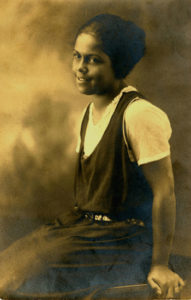
Background Information: Gwendolyn Bennett.
“Bennett is known for her poems short stories. Most of her works were published between the mid-1920’s and late 1930’s. Some notable poems include: “Wind”, “On a Birthday”, “Street Lamps in Early Spring”, “Lines Written at the Grave of Alexandre Dumas” and “Moon Tonight”. Two short stories, “Wedding Day” and “Tokens”, were published in 1926 and 1927, respectively. Her work was based on the Harlem Renaissance; empathizing on Harlem culture, African values and racial pride” (Rohrbach Library Home: Gwendolyn Bennett).
The Wedding Day
- Why do you think Bennett describes Paul Watson very clearly at the beginning of the short story? Why do you think Bennett describes the hatred that Paul has?
- Why was it so important for Bennett to explain in the text Paul’s culture? Why do you think that Bennett mentioned France in the text? “The close of the war gave him his place in French society as a hero” (Bennett143).
- The text that we have been reading in class, the authors have mentioned that the soldiers who have not died from the war… still live at war. By this I mean have internal conflicts due to the trauma they have lived. My point is, why does Bennett only mention in the text “With only a memory of the war and an ugly scar on his left cheek he took up his old life” (Bennett 143). Do you think he ever recovered from the war?
“Gwendolyn Bennett, Poet, and Artist Born.” African American Registry, 29 Jan. 2022, https://aaregistry.org/story/gwendolyn-bennett-was-a-great-poet-and-artist/.
“Rohrbach Library Home: Gwendolyn Bennett: Biography.” Biography – Gwendolyn Bennett – Rohrbach Library Home at Kutztown University of Pennsylvania, 31 Oct. 2018, https://library.kutztown.edu/bennett.
Stragglers in the Dust
- Why do you think Miller mentions the forgotten soldiers? The soldiers that are unknown?? As if the identity of the soldiers are just numbers but not as human beings?? We have seen this couple of times in the readings before.
- Why do you think in the text it mentions on page 3, “NAN. Yuh know it’s kinda nice dat dey bring all dem wreaths and ribbons to put on him, but somehow Ah wishes dey had lef’ him where he was” (Miller 3).
- Why do you think Miller mentions France in the text?
Potential Book Recommendation?
I was scrolling through my best friend’s goodreads today and I saw a book which would tie in well with this class, especially what we have been discussing recently. It is called Lovely War by Julie Berry and it ties in Greek mythology with World War One. From what I can gather, in the story the Greek goddess Aphrodite tells the stories of four different people in World War One to Hephaestus and Ares. A pianist, a soldier with dreams of being an architect, a famous muscian, a Belgian singer, and a famous muscian about to join the 15th New York Infantry(an all African-American regiment) are followed in the war. It seems like a really interesting combination of a lot of what we discuss in class as it handles the war robbing young people of their futures, race issues, romance in the war, and the inevitably of war(as Aphrodite telling the story in a Manhatten hotel room during the height of WWII. No promises the book is any good, but the goodreads reviews are solid so I will probably give it a read since it seems it could be worth it!
The tie in not only reminds me of what we discused in class, but made me reflect on the relationship between Greek mythology and the Great War in general. Beyond the many allusions, like the last name of Jason as a representation of a mythological hero, people look to mythology to try to undersand the war. The fairly recent Wonder Woman film was the first thing to come to mind because it is a good example of how/why mythology and war tie into together. War, especially the Great War, can sometimes just be too terrible to comprehend and people have to look to bigger than life reasons for it. In Wonder Woman, the characters blame the Greek God Ares for the War assuming humans could never create such horrific conflict on their own. Some blame God, others came up with twisted excuses like saying it is because of “sins” humanity(other wise known as giving people basic human rights). I just think it is interesting to evaluate how war impacts the human mind and how people search for reasons behind tragedy.
Alex’s Reading Questions for March 31
Chapter XI marks a distinct shift in the novel. Suddenly, without warning, we find ourselves in the trenches. This is the first actual description of the war that we’ve seen in the novel, and it takes place over halfway through it. I find this to be a really interesting choice that Daly is making, and I have a few questions about it. Why does Daly choose to begin his descriptions of combat so abruptly–do you feel like he’s making a greater commentary about war itself, or is it simply a narrative tactic? How is the war functioning differently in this novel than in the previous novels we’ve read? What insights about the war do we gain by spending so much of the novel physically separate from it?
Daly’s novel is described as having two major conflicts: the tangible, corporeal combat of the war, and the mental/emotional combat of racism. By the end of the novel, do you feel like these two conflicts are equal in their magnitude, or does one feel more significant? Are the scars of one more painful than the other? What seems more impactful to Montie?
When Casper is injured and Montie begins to help him, he states that “war isn’t the only hell that [he’s] been through lately” (69). How do you read this? What is the “other hell” that Casper is referencing?
The last few lines of the novel were some of the most impactful to me. In the final scene, we are presented with Casper and Montie, “two bodies slumped as one,” entangled and side by side in their death. How do you read this? What are the implications of this ending, and what do they tell us about the relationship between war and race? Does race really matter in no-man’s land?
African Americans in the Great War: Daly Vocabulary and Historical Support
How many African Americans served?
When the United States entered the war, African Americans were divided in their responses. Some influential leaders, like W.E.B. Du Bois, viewed military service as an important means towards achieving racial equality and encouraged African Americans to enlist, hopeful that by showing their patriotism and willingness to sacrifice for their country, the nation would no longer deny them civil rights and equal citizenship. Others were disillusioned from the terrible treatment they received in society, and felt that they had nothing to gain from fighting for a country that viewed them as second-class citizens.

While some African Americans did voluntarily enlist when America first entered the war, the War Department limited the number of black volunteers. However, the government’s call for volunteers produced less than satisfactory numbers of white Americans, leading to the enactment of the Selective Service Act in May 1917. This gave the president the power to draft soldiers, and required all men between the ages of 21 and 31 to register.
Ultimately, over 380,000 black men served during World War I. Around 4,000 were volunteers, while the majority (about 367,710) were draftees (Mjagki 76).
Flyer calling for draft registration
Training of African Americans
African Americans were not allowed to serve in the Marine Core, and could only hold menial positions in the Navy. The Army was a little more progressive on this front, as African Americans were allowed to serve in most roles within this branch. However, few African Americans actually got to serve in combat units–most were assigned to labor battalions.

Still, the Army was heavily racially segregated. African Americans attended segregated training camps, where they received very poor treatment. The conditions were inadequate, to say the least–the men went extended periods of time without proper clothing,
lacking proper housing and sanitary facilities, and poor medical treatment. Similarly to the unequal conditions of the segregated camps, the training that African American troops received was also subpar. Many African Americans never got any military equipment, and those that did were often the last men in the camps to get things like weapons and gas masks. Very little was done to prepare black soldiers for active duty, as the white officers who commanded most black soldiers felt this would be a waste of time, citing the fact that most African Americans were assigned to labor units anyway (in addition to racist ideology regarding the intelligence and intellectual capabilities of African Americans) (Mjagki).

Map of U.S. training camps and cantonments

One of the most significant camps was at Fort Des Moines in Iowa, which was an African American officers camp. Here, they trained by practicing drilling, using rifles and bayonets, reading maps, signaling, etc. By October 1917, 639 of the original candidates graduated and were commissioned as captains and first/second lieutenants. Fun fact: Victor Daly actually attended and successfully completed training at the Des Moines camp!
What roles were they given in the war effort?
The roles of African American soldiers in WWI when enlisting in the military preparing to fight in the war. Many African American soldiers served in segregated units that fought to create equality in the nation. The civil rights organization NAACP, “ Soldier Troubles” meaning this form helped to fight against maltreatment of African American soldiers. The men who did not enlist in non-combative roles during WWI served as Services of Supply, consisting of stevedore, labor, and engineers service battalions and companies. The roles in Service Supply helped to support the war such as providing materials. Also, during WWi, African American doctors that served during the war would provide their services for wounded and sick soldiers in “all- African American units”. “ The majority of all African American doctors studied at Meharry Medical College in Nashville, Tenn., Howard University College of Medicine in Washington, D.C. and the Leonard Medical School at Shaw University in Raleigh, N.C.” (Rifenburg). “When World War I broke out, there were four all-black regiments: the 9th and 10th Cavalry and the 24th and 25th Infantry” (Bryan). “By the end of World War I, African Americans served in cavalry, infantry, signal, medical, engineer, and artillery units, as well as serving as chaplains, surveyors, truck drivers, chemists, and intelligence officers” (Bryan).

“Photo credit (Photo courtesy of IIP Photo Archive/NARA/U.S. Department of State)”

Medical Supplies and tools.World War I
The picture taken of an African American soldier, “ William Henry Furrowh of Wilmington served during World War I, worked in the segregated labor unit in the American Expeditionary Forces that Joined the British and French troops along the Western Front in France” (Rifenburg).

William Henry Furrowh’s portrait
How did they come to fight with the French?
African American soldiers started to fight with the French when arriving in “France in 1917 and in early 1918, the 369th United States Infantry, a regiment of African-American combat troops, arrived to help the French Army. Earning the reputation from the Germans as “Hell Fighters,” the 369th was nicknamed the “Harlem Hell Fighters” because the regiment “never lost a man through capture, lost a trench or a foot of ground to the enemy. The 369th was also the first to reach the Rhine River and provided the longest service of any regiment in a foreign army. They fought in the trenches for 191 days and the entire regiment received the Croix de Guerre medal for their actions at Maison-en-Champagne.” (Rifenburg). When arriving in France the African American soldiers were treated with respect and equality. The African American soldiers felt heard and needed with the French instead of the maltreatment they received when fighting with the United States.


“African Americans in the Military during World War I.” National Archives and Records Administration, National Archives and Records Administration, 28 Aug. 2020, https://www.archives.gov/research/african-americans/wwi/war.
Barrow, Mandy. “River Rhine.” Facts about the River Rhine, 26 Mar. 2022, http://www.primaryhomeworkhelp.co.uk/rivers/rhine.htm.
Bryan, Jami L. “Fighting for Respect: African-American Soldiers in WWI.” The Campaign for the National Museum of the United States Army, 2021, https://armyhistory.org/fighting-for-respect-african-american-soldiers-in-wwi/#:~:text=By%20the%20end%20of%20World,%2C%20chemists%2C%20and%20intelligence%20officers.
Rifenburg, Leigh, et al. “African-American Participation during World War I.” Division of Historical and Cultural Affairs – State of Delaware, 13 Apr. 2021, https://history.delaware.gov/world-war-i/african-americans-ww1/.
Scott, Emmet J, et al. “The African American Odyssey: A Quest for Full Citizenship World War I and Postwar Society.” Library of Congress, 9 Feb. 1998, https://www.loc.gov/exhibits/african-american-odyssey/world-war-i-and-postwar-society.html.
Wright, Ben. “Victory and Defeat: World War I, the Harlem Hellfighters, and a Lost Battle for Civil Rights.” Afro – Americans in New York Life and History 38.1 (2014): 35-70. ProQuest. Web. 27 Mar. 2022.
Kimber’s Reading Questions for March 29th
- Daly’s foreword to this story recalls for the reader William Sherman’s labeling of war as hell, and posits that there is a second hell, a less physical hell, and this completes the title in a sense – “Not Only War is Hell.” Daly does not explicitly define this second hell, saying only that it is “a purgatory for the mind, for the spirit, for the soul of men.” Based on what we’ve read thus far, expand on what Daly indicated was a second hell.
- The text has used terms like “battle” and “fight” when describing civil rights related events and issues. How do you read this? How does Daly compare our standard idea of war to this second war back home? And as a follow-up that may be more apt to address after we’ve finished the novel – does he assign more gravity to one war than the other?
- With my last question I want to borrow one Professor Scanlon asked of us. When we read A Farewell to Arms, we were asked if we thought it was a war story or a love story. I was initially tempted to ask the same question of this novel upon Miriam’s introduction, but I think there is a far more relevant classification to be made here. Is Not Only War a novel about war or a novel about race? With the main storyline seeming to center on two men about to go to war but the actual text littered not only with indirect references to, but direct focus on the “damned race prejudice”, “race question”, and “race problem” from nearly every character we’ve met thus far, it is impossible to not recognize those as the points the novel considers with most sincerity. And as I’ve borrowed a question, I will also borrow a disclaimer: “Note: of course all definitions and categories are by nature exclusionary, and so of course this is a perverse writing prompt. Acknowledged, okay?”
The Tower of London Remembers
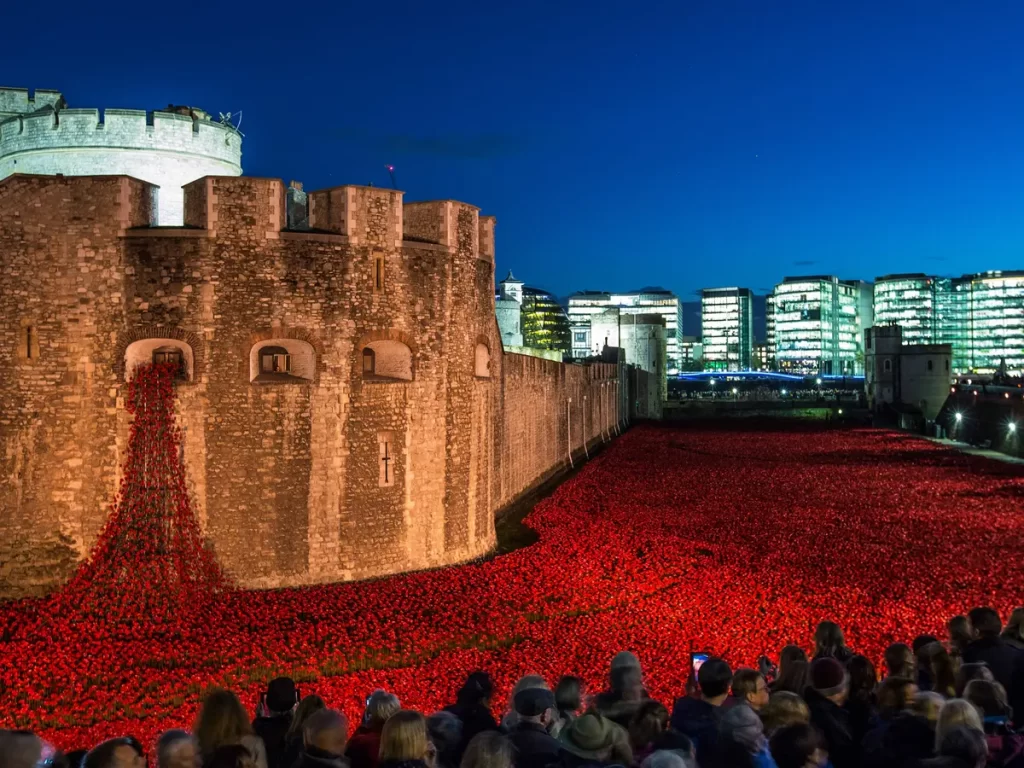
During today’s group discussion on Isaac Rosenberg’s poem “Break of Day in the Trenches,” a question was posed about the significance of the poppy flower. In modern times, the poppy is seen as a tribute and respectful gesture to honor war veterans. It first began in the 1920s, after WWI came to an end. People would pin the flower to their lapels or tuck them in their breast pockets to display their bright color. They were also placed on the graves of deceased soldiers, often by family and comrades who were paying their respects. Poppy flowers are a symbol of remembrance for those that fought and sacrificed for the freedom that we have today. They are a representation of solace, remembrance, and eternal sleep.
When our small group asked Dr. Scanlon about the poppies within the poem, she mentioned a beautiful sight in London, England that we might explore. The Tower of London has created an honorific display of poppies in homage to the soldiers of The Great War. It commemorates their bravery and loss through an extravagant arrangement of ceramic poppy flowers. Hundreds of hours and thousands of flowers were utilized to produce this masterpiece. I think that it is not only gorgeous to look at, but remarkable for its significance. The reason for its creation and the labor put into this display was well-thought-out.
If you would like to learn more about The Tower of London Remembers, here is a link to their website:
https://www.hrp.org.uk/tower-of-london/history-and-stories/tower-of-london-remembers/#gs.v28sdd